
PAS Framework: How to Write Carousel Posts That Sell
Every scroll-stopping carousel starts with the same thing: a problem your audience already feels.
Not a problem you invented. Not a generic pain point pulled from a marketing textbook. A specific, visceral frustration that makes someone stop mid-scroll and think, “That’s exactly what I’m dealing with.”
That’s the power of PAS — Problem, Agitate, Solution — the copywriting framework that outsells everything else when your audience is already aware they have a problem. And for carousel creators, it’s arguably the most natural framework to adopt because the swipe mechanic mirrors the emotional arc perfectly.
What Is the PAS Framework?
PAS breaks persuasion into three stages:
- Problem — Name the pain your audience is experiencing
- Agitate — Amplify that pain by exploring consequences, frustrations, or hidden costs
- Solution — Present your answer as the clear path forward
Unlike AIDA, which builds desire gradually from attention to action, PAS goes straight for the gut. It starts with what hurts, makes it hurt a little more, then offers relief. It’s empathy-driven selling — and it works because people are more motivated to move away from pain than toward pleasure.
Research backs this up. According to behavioral economics, loss aversion means people weigh potential losses roughly twice as heavily as equivalent gains. PAS leverages this directly.
Why PAS Works So Well for Carousels
Carousels are sequential by design. Each swipe is a micro-commitment — the reader is choosing to keep going. PAS turns that sequence into an emotional journey:
- Slides 1-2 (Problem): Hook with a recognizable frustration. The reader swipes because they feel seen.
- Slides 3-4 (Agitate): Deepen the tension. Show what happens if nothing changes. The reader swipes because the stakes feel real.
- Slides 5-6 (Solution): Deliver the payoff. Present your method, tool, offer, or insight. The reader swipes because they want the answer.
- Slide 7 (CTA): Direct them to act — save, share, click the link, DM you.
This maps to 7 slides, which is right in the sweet spot for Instagram carousels (data from Later shows 7-10 slides generate the highest engagement rates, with carousels averaging 0.55% engagement — roughly 2x that of single image posts).
Slide-by-Slide PAS Breakdown
Let’s walk through a real example. Say you’re a business coach creating a carousel about client acquisition.
Slide 1: The Hook (Problem)
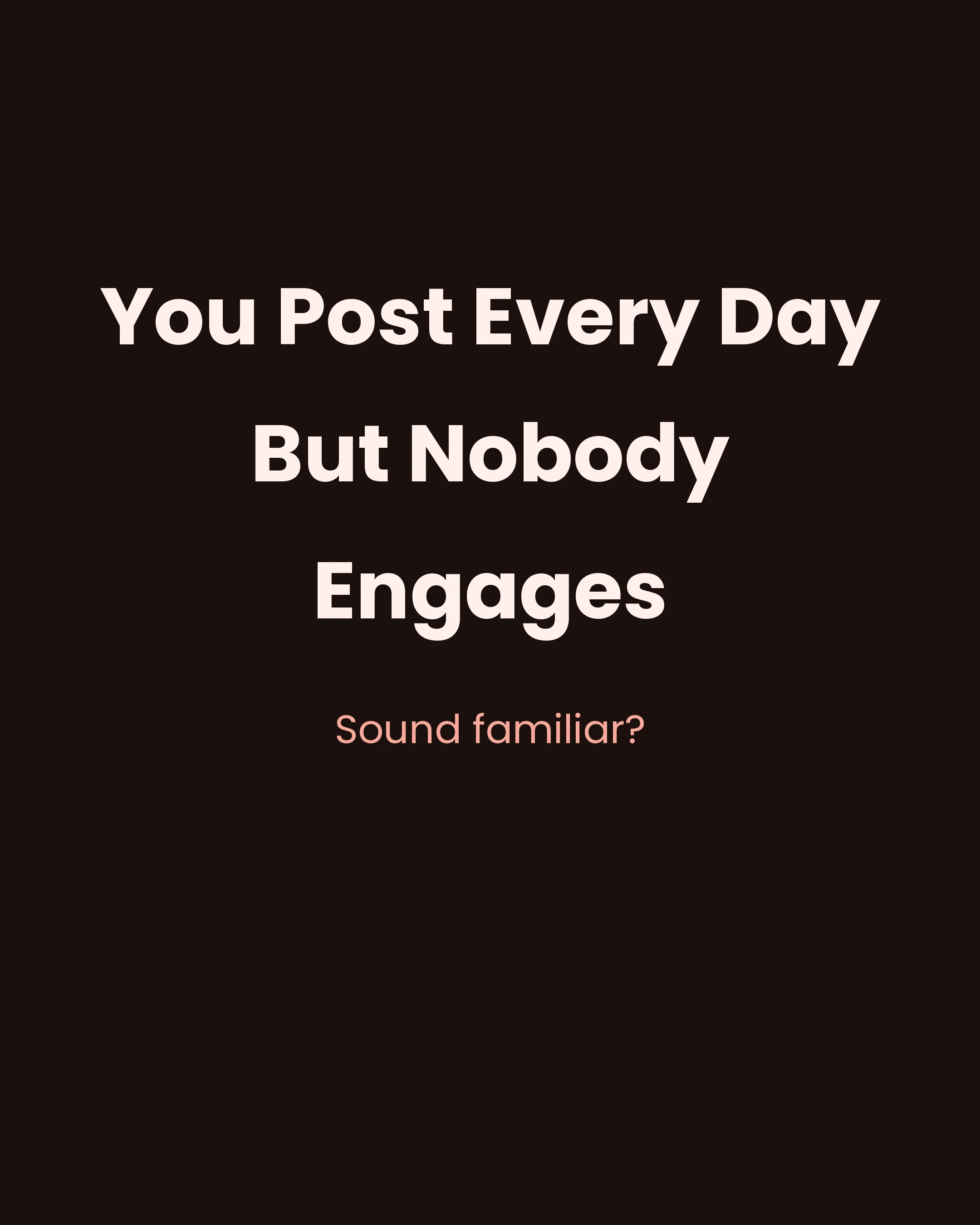
“You’re posting every day but your DMs are empty.”
This works because it names a specific symptom your audience recognizes. Not “struggling with social media” — that’s too vague. “Posting every day but DMs are empty” is a lived experience.
What makes a strong Problem hook:
- Uses “you” language (not “most people”)
- Names a specific symptom, not a category
- Feels personal without being presumptuous
- Creates an immediate “that’s me” reaction
Slide 2: Expand the Problem
“You’ve tried trending audio. You’ve posted quotes. You’ve even tried Reels. Still nothing.”
This slide validates their experience. It tells them you understand what they’ve already tried — and that you’re not going to suggest the same tired advice.
Slides 3-4: Agitate
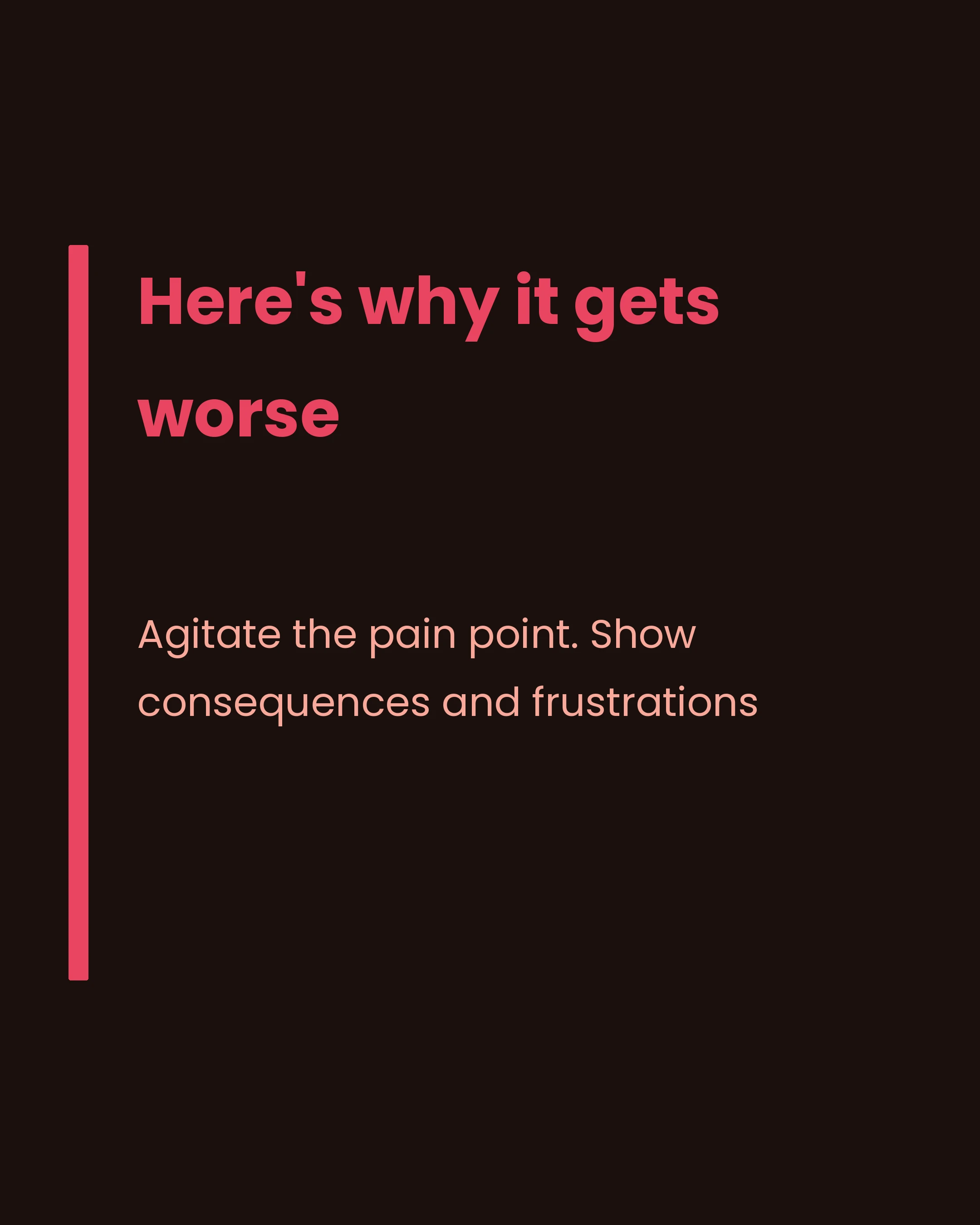
“Here’s what most people won’t tell you: the algorithm rewards structure, not effort. Random posting is the most expensive marketing strategy because it costs your time and returns nothing.”
The Agitate phase is where many creators pull their punches. They name the problem but skip the emotional amplification. That’s a mistake.
Agitation isn’t about being negative — it’s about being honest. You’re articulating the consequences your audience already suspects but hasn’t fully confronted:
- Financial cost: Time spent creating content that doesn’t convert
- Opportunity cost: What they could have built with that time
- Emotional cost: The frustration of doing everything “right” and still not growing
- Credibility cost: Inconsistent, scattered content undermines authority
The more specific you get, the more your reader feels understood.
Slides 5-6: Solution
“Structure your carousel content using proven copywriting frameworks. Start with the pain (like this post does), amplify it, then deliver a clear solution. PAS turns random posts into a persuasion engine.”

Your solution should feel inevitable — like the logical conclusion of everything you’ve just laid out. Don’t introduce new concepts here. Instead, show how the framework resolves the exact tensions you created in the Agitate phase.
Practical tips for solution slides:
- Be specific: “Use PAS to structure your next 5 carousels” beats “try a framework”
- Show the mechanism: Briefly explain why this works, not just that it does
- Include proof: Stats, testimonials, or your own results
- Keep it actionable: The reader should know exactly what to do differently after reading
Slide 7: Call to Action
“Save this for your next carousel. Share it with a creator who needs to hear this.”
A CTA on a PAS carousel should match the emotional journey. You’ve taken the reader from pain to relief — now give them a clear next step. Save, share, comment, or click are all valid. Just pick one primary action.
PAS Variations for Different Niches
The beauty of PAS is its flexibility. Here’s how it adapts across industries:
Fitness coaches: Problem (no time for the gym) – Agitate (health declining, energy crashing) – Solution (15-minute home workouts)
Real estate agents: Problem (house sitting on market for months) – Agitate (price drops, carrying costs, missed opportunities) – Solution (staging and pricing strategy)
Course creators: Problem (have expertise but no students) – Agitate (watching less qualified competitors sell out) – Solution (content-to-course pipeline)
Nutritionists: Problem (always tired despite “eating healthy”) – Agitate (hidden sugar, nutrient gaps, conflicting advice) – Solution (simple plate framework)
PAS vs AIDA: When to Use Which
Both frameworks drive action, but they start from different places:
- Use PAS when your audience already knows they have a problem. They’re searching for solutions, frustrated with the status quo, or stuck. PAS meets them where they are.
- Use AIDA when your audience doesn’t yet realize they need what you’re offering. AIDA builds awareness first, then desire. It’s better for introducing new concepts or opportunities.
In practice, PAS carousels tend to generate more saves (people want to reference the solution later) while AIDA carousels tend to drive more shares (the educational content feels more universal).
Common PAS Mistakes to Avoid
Going too aggressive on the Agitate. There’s a line between honest amplification and fear-mongering. If your agitation slide makes someone feel hopeless rather than motivated, you’ve gone too far. The goal is tension that resolves, not dread.
Weak Problem hooks. “Struggling with marketing?” isn’t a PAS hook — it’s a generic question. PAS hooks name the specific symptom in the reader’s own language.
Rushing to the Solution. If you only spend one slide on Problem and Agitate, the Solution won’t feel earned. Give the emotional journey room to breathe.
Vague CTAs. “Let me know what you think” is not a CTA. “Save this and use it for your next carousel” is.
Building PAS Carousels Faster
Once you understand the PAS structure, the bottleneck shifts from “what do I write” to “how do I produce it quickly.” Tools like Carousel have the PAS framework built in as a content template — you select PAS, enter your topic, and the app generates a structured slide deck following the Problem-Agitate-Solution flow. You can then customize the copy, choose a palette, and export directly to Instagram, LinkedIn, or TikTok.
Key Takeaways
- PAS (Problem-Agitate-Solution) is the most effective carousel framework when your audience already knows they have a problem
- The carousel swipe mechanic naturally mirrors the PAS emotional arc — pain, tension, relief
- Strong PAS hooks name specific symptoms, not categories
- Agitation should be honest and specific, not fear-mongering
- The Solution must feel like the inevitable resolution of the tension you created
- PAS carousels tend to outperform on saves, making them excellent for building evergreen reach
Ready to try the PAS framework on your next carousel? Download Carousel — free on the App Store.